How to Become a CNA

See if you qualify for Certified Nursing Assistant programs
Answer a few questions in 2 minutes. Free, no commitment.
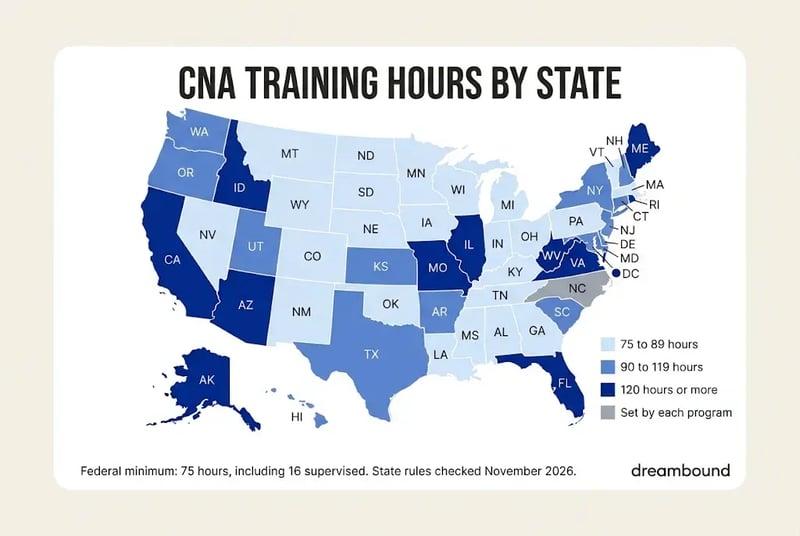
To become a certified nursing assistant (CNA), you complete a state-approved training program, pass your state's two-part competency exam, and get listed on your state's nurse aide registry. Federal rules set the training floor at 75 hours, including 16 hours of supervised hands-on practice. About 20 states require only that minimum, and the rest ask for more, up to 175 hours in Missouri. Many people finish in a few weeks to a few months, and nursing homes often cover the cost for the aides they hire.
Four Steps to Certification
1. Check your state's entry requirements
Programs typically ask for a background check, a health screening, and proof of immunizations, and some want a high school diploma or GED. Minimum ages range from 16 to 18, depending on the state and program, and teens can check the details for becoming a CNA in high school.
2. Finish a state-approved training program
Only state-approved programs count toward certification. Under 42 CFR 483.152, training must run at least 75 clock hours, with at least 16 hours of practical training supervised by a nurse. Before you work with residents, you need 16 hours on communication, infection control, safety and emergency procedures, residents' independence, and residents' rights. Community colleges, career schools, and nursing homes run programs, which you can compare in our list of classes near you. Many use a hybrid format with online lessons and in-person labs and clinicals.
3. Pass the competency exam
Every state tests two things: knowledge, through a written or oral exam, and hands-on skills. Federal rules let you choose the oral version and guarantee at least three chances to pass. Many states use the National Nurse Aide Assessment Program (NNAAP), now owned by Credentia, which pairs a 70-question written test with a hands-on test of five randomly chosen skills. You have to pass both parts, and these CNA exam prep tips cover how to get ready.
4. Get listed on the registry and start working
Once you pass, the state adds you to its nurse aide registry, which employers check before hiring. Federal rules bar states from charging you to be listed. To stay active, keep working: if you go 24 consecutive months without paid nursing-related work, federal rules require you to retrain or retest. Renewal paperwork and timing vary by state, as our guide to renewing a CNA license shows.
Is a CNA a License or a Certification?
It depends on the state, but in every state your name has to be on the nurse aide registry. The National Council of State Boards of Nursing groups CNAs with other "unlicensed, assistive care providers," and most states certify or register nurse aides rather than license them. A few states use the word license anyway: New Hampshire and Vermont issue a Licensed Nursing Assistant (LNA) credential, and Washington's Board of Nursing issues a Nursing Assistant-Certified (NA-C) license.
Titles vary too. Kentucky calls the role State Registered Nurse Aide, North Carolina uses Nurse Aide I, Maryland moved to a single CNA-I credential in April 2026, and Oregon merged its two CNA levels into one in July 2025. The job is the same: basic care under the supervision of a nurse.
Training Hours, Exams, and Registries by State
These figures come from each state's rules or registry pages, checked in November 2026. Hours show the program minimum, with supervised clinical hours in parentheses where the state sets them. Find your state below; linked state names go to our full state guides.
State | Minimum training hours | Exam provider | Registry agency |
|---|---|---|---|
75 (16 clinical) | Credentia (NNAAP) or Prometric | ||
Alaska | 140 (80 clinical) | Credentia (NNAAP) | |
Arizona | 120 (40 clinical) | Headmaster | |
Arkansas | 90 (16 clinical) | Headmaster | |
160 (100 clinical) | Headmaster, Credentia, or Regional Testing Center | ||
Colorado | 75 (16 clinical) | Credentia (NNAAP) | |
Connecticut | 100 | Prometric | |
Delaware | 91 (16 clinical) | Prometric | |
District of Columbia | 125 (40 clinical) | Credentia (NNAAP) | |
120 (40 clinical) | Prometric | ||
85 (24 clinical) | Credentia (NNAAP) | ||
Hawaii | 100 (70 clinical) | Prometric | |
Idaho | 120 (40 clinical) | Prometric | |
Illinois | 120 (40 clinical) | State test through Southern Illinois University | |
Indiana | 75 (45 clinical) | Ivy Tech testing office | |
Iowa | 75 (30 clinical) | Headmaster or Credentia, plus community college skills tests | |
Kansas | 90 (at least half clinical) | State test | |
Kentucky | 75 (16 clinical) | Kentucky Community and Technical College System | |
Louisiana | 80 (40 clinical) | Prometric | |
Maine | 130 (40 clinical) | Two-part state test | |
100 (40 clinical) | Credentia (NNAAP) or Headmaster | ||
75 (87 planned) | Headmaster | ||
Michigan | 75 (16 clinical) | Headmaster | |
Minnesota | 75 (16 clinical) | Headmaster | |
75 (federal minimum) | Headmaster | ||
Missouri | 175 (100 on-the-job) | Headmaster | |
Montana | 75 (federal minimum) | Headmaster | |
Nebraska | 75 (16 clinical) | State-approved testing entities | |
Nevada | 75 | Headmaster | |
New Hampshire | 100 (60 clinical) | Excel Testing | |
New Jersey | 90 (40 clinical) | PSI (written) and Headmaster (skills) | |
New Mexico | 75 (16 clinical) | Headmaster | |
100 (30 clinical) | Prometric | ||
North Carolina | More than 75, set by each program | Credentia (NNAAP) | |
North Dakota | 75 (16 clinical) | Headmaster | |
Ohio | 75 (16 clinical) | Headmaster | |
75 (16 clinical) | Oklahoma CareerTech Testing Center | ||
Oregon | 105 (40 clinical) | Headmaster | |
Pennsylvania | 80 (37.5 clinical) | Credentia (NNAAP) | |
Rhode Island | 120 (40 clinical) | Credentia (NNAAP) | |
South Carolina | 100 (40 clinical) | Credentia (NNAAP) | |
South Dakota | 75 (16 clinical) | Headmaster | |
Tennessee | 75 | Credentia (NNAAP) | |
100 (40 clinical) | Prometric | ||
Utah | 100 (24 clinical) | State test | Utah Nursing Assistant Registry |
Vermont | 75 (16 clinical) | Excel Testing | |
140 (40 clinical) | Credentia (NNAAP) | ||
108 (40 clinical) | Credentia (written); skills test in programs | ||
West Virginia | 120 (55 clinical) | State-approved provider | |
Wisconsin | 75 (16 clinical) | Headmaster | |
Wyoming | 75 (federal minimum) | Headmaster |
Recent changes to watch:
- Indiana cut its minimum from 105 hours to 75 in September 2025.
- Washington moved nursing assistants to its Board of Nursing and set a 108-hour minimum in July 2026.
- Tennessee switched its exam to Credentia in June 2026.
- Massachusetts has announced a rise to 87 hours, with no start date yet.
If you're close to enrolling, confirm the current numbers with your state's registry.
Who Pays for Training?
Often an employer. Under federal rules, a nursing home that takes Medicare or Medicaid can't charge you for any part of your training or competency exam, including textbooks, if it employs you or has offered you a job when the program starts. If you pay your own way and one of these nursing homes hires you within 12 months of finishing, the state must reimburse part of your costs, spread over the time you work there. Here are the ways to become a CNA for free and how to find them.
If you pay yourself, prices vary by school and state. As of November 2026, Dreambound's partner programs in Texas, for example, list total tuition of $920 at Diamond Career Institute, $1,050 at TSC Career Institute, and $1,450 at Williams Career School of Excellence. Budget for exam fees, scrubs, and a background check on top. The American Red Cross, once a common place to train, discontinued its Nurse Assistant Training program and scheduled no courses after December 31, 2023, so older guides that point you there are out of date.
Pay and Career Questions
How much do CNAs make?
Nursing assistants earned a national median of $42,260 a year, or $20.32 an hour, in May 2025, according to the Bureau of Labor Statistics. The top 10 percent earned just over $51,980, so $100,000 isn't a realistic CNA salary. Our CNA salary breakdown covers pay by state and setting.
Is CNA the lowest level of nursing?
A CNA is an entry-level role on the nursing team, but it isn't a nursing license like an LPN or RN license. Nursing assistants give basic care under the supervision of licensed practical nurses and registered nurses, and many work as CNAs while they train for those licenses. If you're planning that path, see what comes after CNA.